Mapmattery and other semi-worthy slop.
Cultural coarse-graining.
00:00:03 Speaker 1
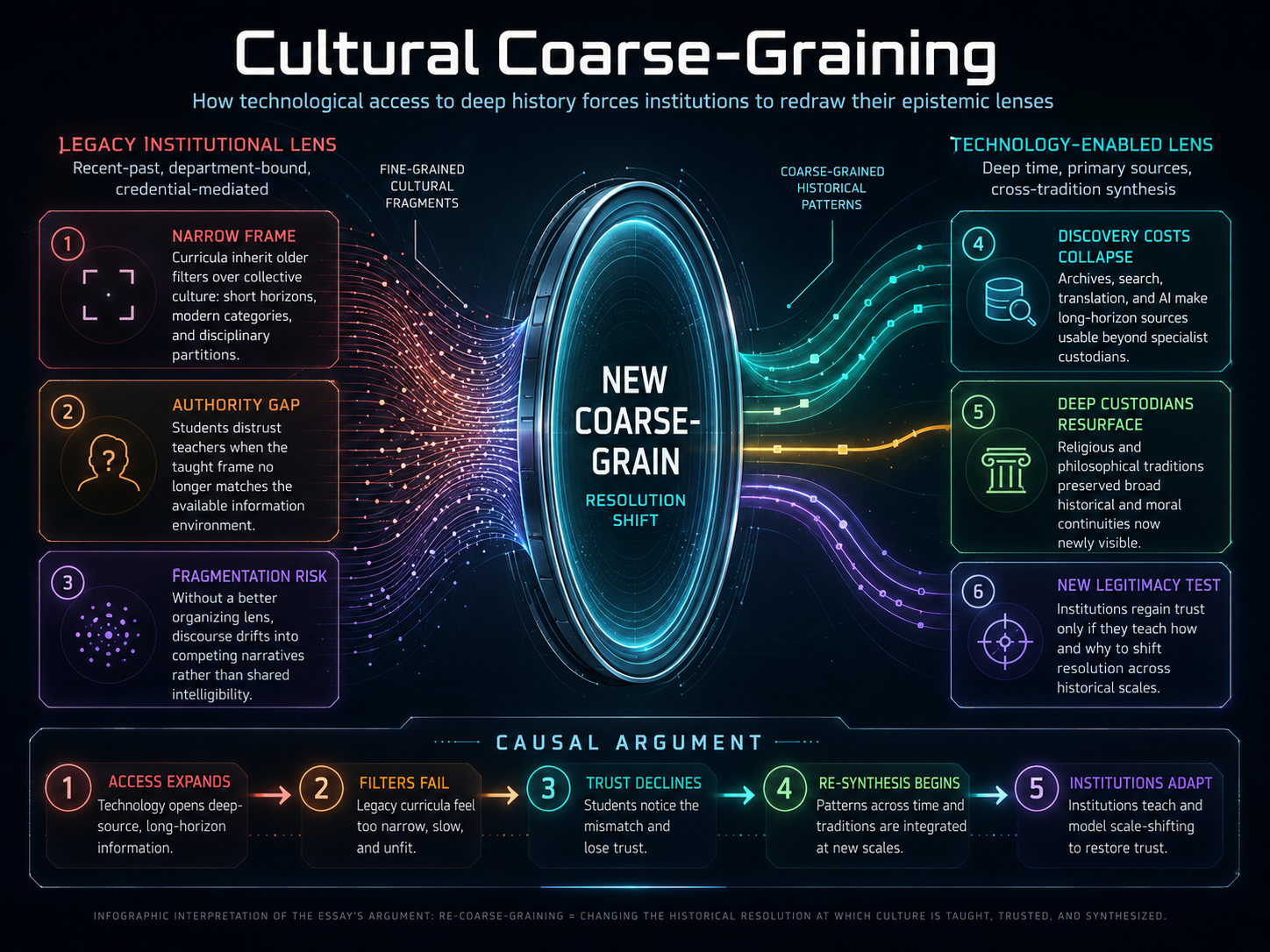
We're going through some kind of a new type of coarse graining in culture, I think. I think the younger generation is realizing that we need to look at our collective human history with a different type of coarse graining than the levels that had been applied before. And so You know, we see the problem in schools that students aren't really trusting teachers, and I think rightfully so in some sense. Even at university level, traditional frameworks are based on older types of course-graining across our collective culture. And I think now we're looking at conversations and discourse that's kind of seeking to reframe.
00:01:00 Speaker 1
Uh, or recourse grain over our collective history. So what I'm, What inspired this thought was listening to the Pope's encyclical? And he's talking about the history of a lot of these ideas and going back to periods of time that way predate the periods over which we sort of would within the past I. Think few generations of education. We would typically. Go to only real religious scholars in the recent past had been engaged with those types. Of course, grading and that degree of history in terms of relevance. But I think we're now being shown that we can declare a wider sort of a different course grading over our collective history. Partially, this is.
00:01:59 Speaker 1
This actually, I think it's what's important to note here, is that this enabled by technology. So, you know, we it's sort of this weird kind of paradoxical situation that it's technology that's enabling us to now have this new type of coarse graining over our collective cultural history going into. A new cultural era, human era. However, you know, The lessons that are being highlighted as a result of being able to do this, at least initially are sort of religious references. It's been in the domain of the religious scholars to be holding the candle for a lot of these ideas until recently.
00:02:57 Speaker 1
So anyway, I just wanted to get these thoughts down and see what I can do to develop them further.
## Core Synopsis
Culture is undergoing a re-coarse-graining of collective history: technology has widened access to deep time and primary sources, and younger audiences are rejecting institutional narratives built on narrower historical lenses, forcing a reframe of what counts as relevant knowledge. The transcript points to an authority gap in schools and universities, where traditional frameworks and gatekeeping no longer match the breadth and granularity now possible; it cites religious scholarship (via the Pope's encyclical) as a domain that preserved long-horizon perspectives, which technology is now mainstreaming. The causal chain is straightforward: expanded information access (mechanism) exposes the limits of conventional educational coarse-graining (symptom), leading to distrust (signal) and catalyzing new discourse that blends longer timeframes and previously siloed traditions (response). The stakes are institutional: education and cultural leadership either redesign their coarse-graining to match this technological reality or cede authority to alternative narrative systems; we are responsible for deciding whether to anchor this shift with a clear framework or let it drift into fragmentation.
## Reframing History: Diagnostic and Dialectical Structure
- The Hypothesis: A New Cultural Coarse-Graining
Culture is moving from a recent-past, institution-curated lens to a broader, deeper time lens that integrates ancient sources and long-range continuity, enabled by ubiquitous access and computational tools.
- Evidence Signals: Education and Discourse
- Students' declining trust in teachers signals a mismatch between legacy curricula and the expanded information environment.
- University frameworks anchored in modern-era abstractions appear misaligned with a public conversation that increasingly invokes older sources and cross-tradition references.
- Mechanism: Technology as Enabler
- Digital archives, search, and AI compress discovery costs, making canonical texts and long-horizon analysis accessible beyond specialist circles.
- Networked discourse elevates historically marginal perspectives and accelerates synthesis across traditions.
- Dialectic: Tech Modernity vs Religious Custodianship
- Thesis: Technology pushes culture toward empiricism and present-focused pragmatism.
- Antithesis: Religious scholarship has preserved deep historical continuity and moral frameworks outside modern academic fashion.
- Synthesis: Technology mainstreams long-horizon religious and philosophical insights without requiring institutional mediation, creating a hybrid narrative space where secular and sacred sources cohere under a new coarse-grain.
- Implications: Institutional, Curriculum, and Legitimacy Shifts
- Institutions must update epistemic filters (what gets taught, why, and at what granularity) to regain trust.
- Curricula will need to anchor contemporary issues in long-range historical contexts and cross-tradition synthesis.
- Legitimacy will flow to actors who can articulate a clear framework for how to coarse-grain culture under technological abundance.
## Action Items
@Speaker
- [ ] Define "coarse-graining" for cultural analysis with a 1\[Dash]2 page working paper that contrasts legacy academic lenses vs. technology-enabled lenses (include examples) - [TBD]
- [ ] Compile a source list (Pope's encyclical + 5 additional long-horizon texts from different traditions) and extract 3\[Dash]5 recurring motifs that reappear in modern discourse - [TBD]
- [ ] Map the technology stack that enables re-coarse-graining (archives, search, AI summarization, provenance tools) with a simple capability matrix - [TBD]
- [ ] Conduct 5 structured interviews (2 students, 2 educators, 1 religious scholar) to validate distrust signals and framework gaps; synthesize findings in a 2-page memo - [TBD]
- [ ] Draft a prototype curriculum module (90 minutes) that teaches a contemporary issue through deep-time sources and modern tools; pilot with one class or reading group - [TBD]
- [ ] Write a position essay (1,500\[Dash]2,000 words) articulating the new coarse-graining paradigm and its institutional implications; submit to a public forum or journal - [TBD]
Here is a draft of the working paper requested in your action items, expanding on your spoken reflections to clearly define "coarse-graining" in a cultural context.
Following the paper, I have designed an interactive tool to help visualize how adjusting these "lenses" alters the information and narratives we consume.
---
# Working Paper: Coarse-Graining in Cultural Analysis
Shifting Epistemic Lenses in the Information Age
### 1. Introduction: The Concept of Cultural Coarse-Graining
In statistical mechanics, "coarse-graining" is the process of reducing the resolution of a system. By smoothing out microscopic fluctuations (like the erratic movement of individual atoms), one can identify macroscopic properties (like temperature or pressure).
Applied to cultural analysis and history, coarse-graining refers to the "lens resolution" through which we view human events, ideas, and timelines. A high-resolution (fine-grained) view focuses on day-to-day events, specific individuals, and short-term political cycles. A low-resolution (coarse-grained) view collapses these granular details to reveal deep-time patterns, civilizational arcs, and enduring moral frameworks. Culture is currently undergoing a massive "re-coarse-graining," shifting away from the hyper-specialized lenses of the recent past toward broader, synthesized perspectives.
### 2. The Legacy Academic Lens: Specialized and Compartmentalized
For the past several generations, institutional education (schools and universities) has relied on a specific, relatively fine-grained historical framework.
*The Paradigm:** Knowledge was heavily compartmentalized into distinct disciplines (e.g., modern history, sociology, political science). The time horizons were relatively short, often prioritizing post-Enlightenment or 20th-century frameworks.
*The Symptom:** This hyper-specialization successfully generated deep technical and empirical insights but stripped away the grand narratives that connect human history across millennia.
*The Trust Gap:** The modern student's declining trust in teachers and university frameworks stems from this mismatch. Students intuitively sense that a highly partitioned, short-horizon view of culture fails to map onto the complexities of the modern world. The legacy frameworks feel inadequate for making sense of existential, technological, and global-scale shifts.
### 3. Technology as the Enabler of a New Coarse-Graining
Paradoxically, it is hyper-modern technology\[LongDash]ubiquitous digital archives, search engines, and AI synthesis\[LongDash]that is enabling us to adopt a much older, broader lens.
*Collapsing Discovery Costs:** Previously, engaging with deep-time history across multiple traditions required a lifetime of specialized archival study. Today, technology allows curious individuals to access, translate, and synthesize canonical texts, philosophical treatises, and ancient histories instantly.
*Networked Synthesis:** Digital discourse platforms have elevated historically marginal or siloed perspectives, allowing public intellectuals and synthesizers to weave together patterns across eras without needing institutional gatekeepers.
*The Result:** Technology is pushing culture out of its present-focused pragmatism and mainstreaming a long-horizon perspective. We are zooming out.
### 4. The Role of Religious and Ancient Custodians
As culture seeks this wider coarse-graining, it inevitably rediscovers the institutions that have continuously operated at this macro-level.
*The Custodians of Deep Time:** Until the digital age, religious scholars, theologians, and philosophers were among the only groups actively maintaining a low-resolution, deep-time lens. Texts like a Papal encyclical inherently coarse-grain human history, bypassing daily political noise to address centuries-long threads of human dignity, ecology, and morality.
*Synthesis of Sacred and Secular:** Modern individuals are turning to these ancient moral frameworks (e.g., Stoicism, theological stewardship, Eastern philosophies) not necessarily out of dogmatic religious conversion, but because these traditions hold the vocabulary for the wide-lens coarse-graining they are seeking.
### 5. Examples of Competing Lenses
*Ecology and Climate:**
Legacy Lens (Fine-Grained):* Views the environment through immediate economic impacts, carbon quotas, and short-term policy debates.
New Lens (Coarse-Grained):* Views the environment through deep-time ecology and human stewardship, aligning modern climate data with ancient concepts of creation care and generational duty.
*Institutional Legitimacy:**
Legacy Lens (Fine-Grained):* Authority flows from specific 20th-century credentials and specialized departments.
New Lens (Coarse-Grained):* Authority flows to those who can articulate a coherent narrative that synthesizes the wisdom of antiquity with the technological realities of the future.
### 6. Conclusion and Institutional Imperatives
We are at a transition point where the public's capability to cross-reference history vastly outpaces the narrow curricula of traditional educational institutions. To regain trust, educational and cultural leadership must redesign their epistemic filters. They must actively teach students how to shift between different levels of coarse-graining\[LongDash]knowing when to zoom in on empirical details, and when to zoom out to the moral and civilizational patterns preserved by our collective history.
---
### Exploring Cultural Coarse-Graining
To further explore this concept, I've built a simulator that demonstrates how shifting the "coarse-graining level" changes the cultural narrative, the authoritative sources, and the time horizon of our collective history. Adjust the slider to see how different zoom levels filter human experience.
Cultural Coarse-Graining Explorer
Adjust the slider to shift the historical lens resolution.
The Daily Noise
Extremely High
Days to Months
Viral cycles, pundits
Social algorithms