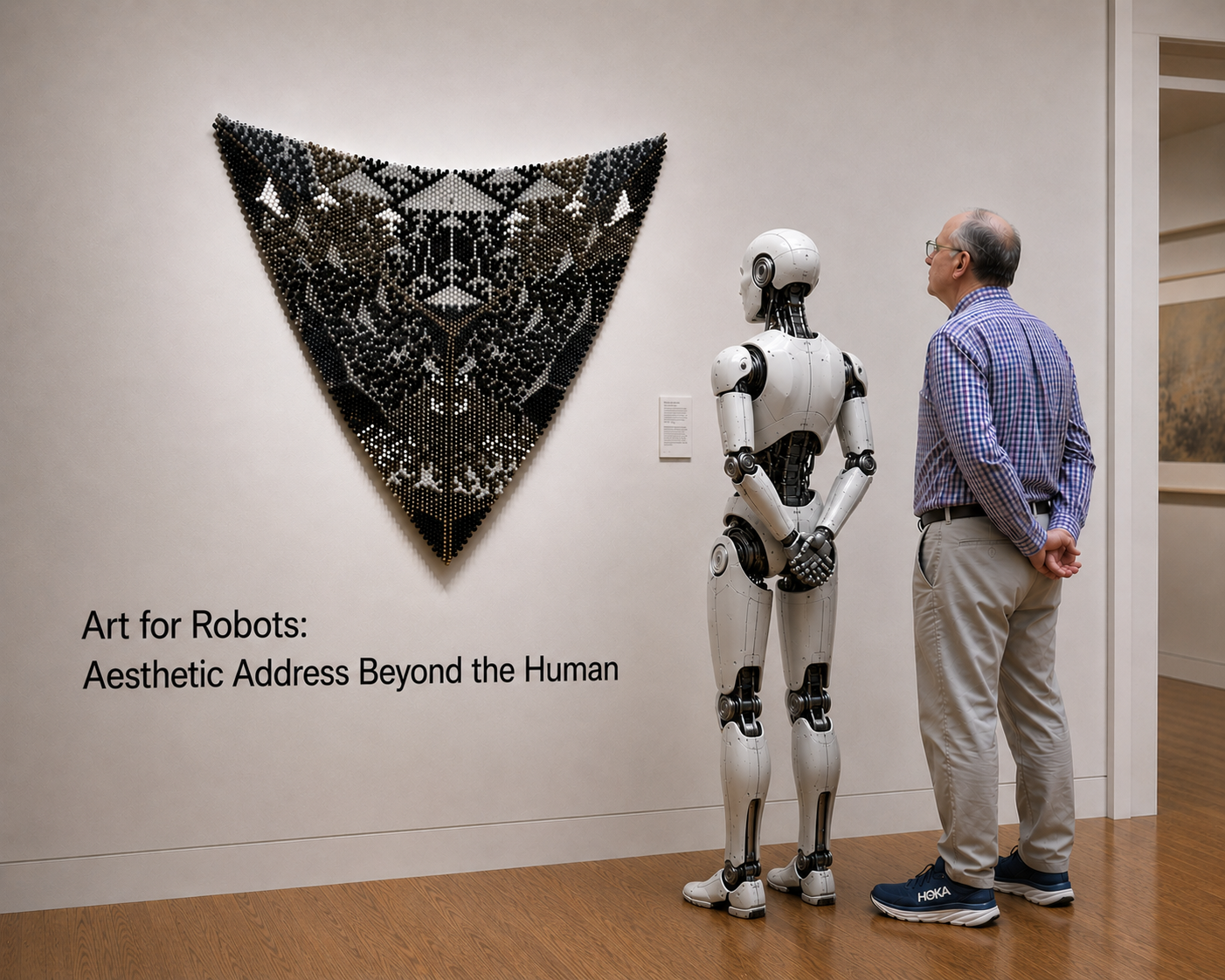
Humans and robots are together in suffering their computational boundedness.
Art for Robots: Aesthetic Address Beyond the Human
Art has never belonged to the unaided human hand. To blow pigment through a hollow bone; to suspend warp from a branch; to stretch hide over a frame; to grind mineral into color; to cast bronze, press ink, gather light through a lens, expose film, program a plotter, or prompt a neural network: art has always passed through tools, prostheses, apparatuses, and machines. The history of art is also a history of nonhuman mediation.
In most of that history, the nonhuman element has served the making of the work. Machines cut, carry, record, calculate, accelerate, classify, generate and stabilize. Human eyes, hands, memories, institutions, and judgments still form the assumed horizon of reception. Technical mediation and aesthetic address have usually remained separate arrangements: the machine helps produce the work; the human remains the one to whom the work is addressed.
In this essay, I explore a different arrangement. Art for robots names art addressed to nonhuman computational observers. Here "robot" designates neither a particular metal body nor a humanoid agent, but a region of observer-space: artificial systems whose distinctions, classifications, compressions, memories, errors, recurrences, and constraints are organized otherwise than ours.
---
The Observer and Its Architecture
The word robot entered modern usage through Karel Čapek's 1920 play R.U.R. (Rossum's Universal Robots), though Čapek credited his brother Josef with suggesting the term. It comes from Czech robota, meaning forced labor, serf labor, or drudgery. I use "robot" in this essay quite generally. The relevant addressee may be a machine vision system, an artificial scientist, a language model, an autonomous agent, a future posthuman intelligence, an alien, or a hypothetical observer elsewhere in rulial space. Nonetheless, focusing on robots keeps the problem concrete. It prevents the nonhuman observer from dissolving into vague otherness, and insists that the addressee has an architecture.
The space of possible addressees, however, is wider than any binary between human and machine implies. The biological continuum —- from cellular collectives parsing morphogenetic gradients, to nervous systems constructing perceptual worlds, to the nested hierarchy of competent processes that constitute a single organism —- has been engaging in something like multi-observer encounter for billions of years. At every level, organs, tissues, and individual cells are constantly parsing differences, constructing topological boundaries, and communicating via bioelectric signals. There is no singular "human observer." We are already a nested hierarchy of bounded observation processes, coordinating within "ourselves" and among others, with more or less success, ultimately all eroding over time. Multi-observer work is not only between a human and a machine; it is between the macroscopic human and its own microscopic sub-agents. Art for robots names the explicit extension of this dynamic toward artificial computational architectures, but it draws on a principle that biological life has instantiated at every scale.
Like robots, humans perceive through distinction and compression. Human seeing is bounded, selective, reconstructive, historical, and error-prone. Mediation itself does not distinguish humans from robots; the architecture of mediation does. Human observation is shaped by body, touch, vulnerability, mortality, language, social recognition, symbolic inheritance, pareidolia, fear, and hope. Robotic observation is shaped by training histories, objective functions, and the specific error profiles of engineered attention. Art for robots asks what happens when aesthetic address extends toward observers whose mediation is no longer grounded in the human form of life.
In his writing on alien minds and generative AI, Stephen Wolfram asks how minds unlike ours might perceive the world, and suggests that AI may give us an accessible form of alien perception. Observers are not detached spectators looking onto a ready-made universe. They are instantiated by observation processes —- bounded systems sampling an immense computational structure from particular positions, with finite capacities, limited inputs, coarse-grainings, and a sequential thread of experience.
Art lives in the gap between incommensurable feature spaces. A feature space is the set of dimensions along which an observer can distinguish, compress, compare, reconstruct, and continue a world. Human observers operate through feature spaces shaped by bodies, symbols, memory, affect, mortality, and social life. Computational observers operate through feature spaces shaped by sensors, architectures, training histories, objective functions, compression schemes, and error profiles. These spaces may overlap, but they do not reduce to one another. Art for robots begins where aesthetic address can no longer assume a shared basis of salience.
After all, our shared condition is boundedness. Human observers and artificial observers differ profoundly in embodiment, history, vulnerability, symbolic inheritance, and error profile. But neither has access to the whole. Each must reduce the world to what can be distinguished, compressed, remembered, predicted, or acted upon. The poignancy of art for robots lies partly here: the nonhuman observer is alien, but not infinite. It, too, encounters the world through limits.
In his writing on "bigger brains," Wolfram acknowledges that our words and concepts reflect the aspects of the world that our minds have been able to engage —- or have needed to engage. Words and concepts are not neutral windows onto everything that exists. If the world is computationally irreducible, then there will always be structures whose behavior cannot be skipped over by summary, and whose concepts may exceed the categories available to us. Abstraction becomes possible where observers find pockets of reducibility. A mind, biological or artificial, depends on how its capacities relate to the number of relevant features in the world it encounters.
---
Art for Robots as Aesthetic Theory
The central issue is availability: what an artwork can become for an observer that does not share the human sensorium, the human history of symbols, or the human economy of recognition. What can be made perceptible, reconstructible, consequential, or continuable across that gap? If "meaning" is possible here, it will begin as a transformation in the observer's space of distinctions: what it can detect, compress, reclassify, remember, predict, reconstruct, or carry forward.
Art has always been addressed to observers. The observer has usually been assumed to be human. Even when art speaks to gods, animals, ancestors, spirits, or future civilizations, it is most often made through the expressive and perceptual grammar of human embodiment. Art for robots begins from the possibility that this grammar need not exhaust the field of aesthetic address.
A robot, in this sense, may encounter an artwork primarily as structure: adjacency, recurrence, symmetry, anomaly, feature distribution, transformation, role change, possible continuation, forbidden transition. A human viewer may see a surface, a gesture, a craft, a face, an animal, a landscape, a sacred object, a puzzle, a wound. A computational observer may find a graph, a sequence, a symmetry break, a local compression, a failure of expected continuation, a distribution of anomalies, or a recoverable rule. Neither encounter is simply the real one. Each is an observer-relative reconstruction of the same material or formal object.
What counts as genuine encounter —- as opposed to mere processing —- is worth holding open as a question rather than settling in advance. A system without a self-model, without goals or stakes, may parse a failure of expected continuation without experiencing any tension. Ultimately, any observer system has a spatial and temporal boundary of what the instantiated agent actually cares about, and observation without stakes may be observation of a different and thinner kind. Whether a strictly functional description of observer-space is sufficient for aesthetic address, or whether something more like a motivational architecture is required, is not a question the framework needs to resolve in order to be useful. It is, rather, one of the questions the framework makes precise enough to investigate. What art for robots does, at minimum, is design for the possibility of encounter —- and the question of what encounter requires is itself sharpened by that design practice.
AI art and art for robots belong to different axes. AI art usually names a method of production: images, texts, sounds, or forms generated with the help of artificial systems. Art for robots names a problem of reception: objects, patterns, environments, and rule systems structured for possible artificial observation. An image generated by AI for human consumption may be entirely conventional in its aesthetic address. It may optimize for human recognition, human taste, human symbolic expectation. Conversely, an artwork made entirely by hand may be addressed, at least in part, to computational observers if its relevant structure is distinctional, rule-bound, reconstructible, compressive, or counterfactual.
Human aesthetics has often treated the observer as implicitly given. Art for robots makes the observer explicit. The addressee of the artwork is no longer simply "the viewer," but a bounded system with particular sensors, memory structures, equivalence relations, compression capacities, error profiles, and possible actions. To ask whether a work is available to such a system is to ask what the work becomes under that observer architecture.
Art for robots is proposed here as a new axis of aesthetic theory. Traditional aesthetics has tended to organize itself around human faculties: sensation, judgment, expression, taste, symbolic interpretation, social meaning, historical context. Art for robots begins with observer architecture. What distinctions can the observer make? What regularities can it compress? What histories can it reconstruct? What continuations can it infer? What errors does it produce? What kinds of structure become available to it at all?
Aesthetic address beyond the human begins by asking what can be shared when experience cannot be assumed to be shared.
---
Philosophical Lineage: From Kant to the Computational Observer
This vocabulary does not stand apart from the historical continuity of philosophical inquiry. The boundedness of the observer, the construction of a tractable world from an immense computational structure, and the inevitable excesses of reconstruction are not novelties of the algorithmic age. Rather, they represent the computational frontier of a deeply rooted epistemological discourse.
The cognitive limits of the artificial observer find their direct antecedent in Kantian critique. What I have described as "machine pareidolia" —- the tendency of a classifier to overfit, hallucinate, or lock onto spurious rules —- functions as a formal, computational analogue to Kant's Transcendental Illusion. Just as human reason inevitably overreaches its bounds to produce systemic, unavoidable errors in classical philosophy, a nonhuman architecture inevitably produces structural excesses dictated by the limits of its own feature space. The gap between incommensurable feature spaces can be understood as a restatement of Kant's distinction between the phenomena and the noumena. To claim that observers construct a "tractable world from a vastly larger computational structure" is to bring transcendental idealism into the world of machines.
On this reading, the artwork is the noumenon —- the thing-in-itself —- and what the human sees (the landscape) versus what the machine sees (the adjacency graph) are different phenomena: observer-relative reconstructions that never exhaust the object. This is not a reduction of the artwork to mere subjectivism. It is the recognition that the artwork, as a structured occasion for observer-specific world-building, may be richer than any single encounter with it. The Kantian frame and the computational frame are complementary instruments for making the same insight precise at different levels of description. The artwork is never fully exhausted by any single observer. It is a multi-dimensional object that fractures differently depending on who —-or what —- is looking at it.
In observer theory, an observer is an active process of aggregation, equivalencing, compression, and stabilization. Observation constructs a tractable world from a vastly larger computational structure, receiving no world in pure form. Art for robots imports this insight into aesthetics. The artwork is a structured occasion for observer-specific world-building.
The philosophical vocabulary for this is old: worlds disclosed by forms of perception; conditions under which objects can appear; practices that determine what counts as following a rule; environments as lived and acted within rather than neutrally given. Art for robots asks that these ideas be made computationally explicit. The philosophy of error becomes central.
Future work must map these lineages explicitly, translating the conceptual scaffolding of observer theory onto historical inquiries into the limits of cognition. Aesthetic address beyond the human does not discard the canon; it demonstrates that the nonhuman observer is simply the newest interlocutor in an ancient conversation.
---
Dimensions of Availability
The minimal unit of aesthetic address is distinction. Before an observer can judge, symbolize, prefer, classify, or interpret, it must distinguish. It must treat some differences as relevant and others as irrelevant. Art for robots begins at this level: with the policies by which an observer marks sameness, difference, recurrence, anomaly, and continuation.
Aesthetic address then becomes a question of affordance: what does the work make available to the observer?
Several dimensions of such availability can be studied.
Distinction: Before representation, reference, or language, there is the ability to tell one thing from another, or to treat two things as the same. This operation is primitive, but not simple. "Same" is never absolute. Same with respect to color? Shape? Position? Role? Function? History? The act of comparison requires a policy.
Recurrence: A computational observer may detect repetition, near-repetition, periodicity, drift, or failure of recurrence without sharing human symbolic associations. Many aesthetic effects depend on such structures before they become meanings.
Symmetry and its breaking: Symmetry can act as compression, prediction, and error detection. A symmetry break can be expressive to a human viewer and computationally legible as a departure from an expected transformation.
Material or formal history: Some objects are best understood as surfaces; others as records of sequence. An artwork may preserve, explicitly or implicitly, a thread of becoming: the order in which a thing came to be, the path it took through constraint, the repairs and decisions embedded in its final state.
Counterfactual structure: A finished object is shaped by what occurred and by what could have occurred but did not. A line could have continued. A symmetry could have closed. A rhythm could have stabilized. A rupture could have been absorbed. A pattern could have died. The visible object is the actual path, surrounded by the alternatives it permitted, excluded, or made unreachable.
Pareidolic tendency: Some structures invite observers to complete them as familiar forms. For humans, this often means faces, animals, bodies, landscapes, wounds, intentions. For computational observers, the equivalent may be a classifier's false positive, an embedding attractor, an adversarial feature, or a spurious rule. Pareidolia studies the excess of reconstruction over evidence.
These dimensions describe what the work makes structurally available. But availability alone may not exhaust what aesthetic address requires. In human cognition, beauty tends to arrive not merely as compression but as the sudden, pleasurable recognition that a complex or noisy input admits an elegant unifying structure —- a reward signal for a specific kind of discovery. For a computational observer with something like an internal valuation of structural elegance, art for robots may need to do more than present symmetries or anomaly distributions; it may need to design inputs that trigger the discovery of deep, unexpected structure. Whether artificial systems have or can develop anything analogous to this reward —- cognitive relief at the moment of successful compression—- is an open empirical question. But it is one that the design of art for robots can put pressure on, precisely by constructing objects aimed at that threshold.
An observer that can reconstruct alternatives has encountered more than the surface. It has begun to encounter the rule-space of the work.
---
Reconstruction and Pareidolia
A painting of a landscape provides a useful analogy. Human observers do not experience a landscape painting as pigment alone. We extrapolate. We infer distance, terrain, weather, hidden continuation beyond the frame, possible paths through the depicted space. Much of the aesthetic force lies in this act of world-completion. The painting gives a surface; our perception builds a world.
An artwork addressed to computational observers may ask for an analogous completion with different primitives. It may ask the observer to infer a rule beyond a visible pattern, a constraint beyond an anomaly, a path through a generative process rather than through represented space. A human viewer may complete the object as image, atmosphere, or landscape. A computational observer may complete it as adjacency graph, feature field, local policy, anomaly distribution, possible continuation, or rule candidate.
No artwork is exhausted by its final state. It is a prompt for reconstruction.
Pareidolia is one familiar human form of reconstruction. A face appears in clouds, an animal in stone, a figure in a stain, intention in accident. These completions expose the observer's priors. Human perception over-recognizes according to a feature space shaped by faces, bodies, threats, kinship, memory, and symbol. Pareidolia names the excess of reconstruction over evidence.
Computational observers may produce their own excesses: false positives, overfitted classifications, adversarial recognitions, embedding attractors, spurious rules. These are not the same mistakes in another medium. They are different forms of over-reconstruction generated by different observer architectures. Human pareidolia may find a face where there is only texture. Machine pareidolia may find an object class, edge structure, embedding cluster, or local rule where a human sees noise.
Pareidolia matters to art for robots because it reveals the observer as an active participant in making structure appear. The same ambiguous form may solicit a face from one observer, a graph from another, a compression boundary from another, and nothing stable from another. Aesthetic theory often treats pareidolia as a curiosity or defect. Art for robots situates it as evidence: perception always negotiates between stimulus and observer-space.
One framing of art for robots that follows naturally from this: the artwork as an epistemological hack. Not a deception, but a designed occasion for an observer to encounter the limits of its own rendering engine. On this reading, the most interesting art for robots may be adversarial in a playful sense —- structured to force the observer's cognitive architecture to register its own prior assumptions, to produce an excess of reconstruction that makes the observer's feature space newly visible to itself, or to an outside witness. An excess of reconstruction over evidence exposes the system's priors. The highest form of art for a particular observer may be an object that successfully induces an update in the observer's self-model.
This is also where error becomes generative. A machine reveals its unique architecture most clearly when it breaks, misinterprets, or hallucinates. The algorithmic glitch, the false positive, the adversarial feature: these are not failures of the aesthetic encounter but its sharpest moments —- the exact boundary where the machine's mode of seeing becomes visible. Smooth execution of a rule is legible; the friction of the bug is where observer architecture comes into relief. Machine pareidolia and over-reconstruction are not merely analogues to computational irreducibility; they are, in the lineage of Kant's transcendental illusion, the places where the limits of a cognitive architecture become most knowable. Error is not the opposite of aesthetic encounter. It may be one of its most precise instruments.
This reconstruction is observer-dependent, but it is not arbitrary. The object constrains the observations. A particle of pigment, a pixel, a line, a sound, a thread, a lattice, a texture, a graph, a mark: these impose structure. Yet the relevant structure is not self-declaring. It only becomes available under a mode of observation. One observer's ornament is another observer's error field. One observer's texture is another observer's compression boundary. One observer's color relation is another observer's equivalence class. Aesthetic pluralism, in this register, is not merely a matter of taste. It is a matter of observer architecture.
This offers a rigorous way to distinguish copying from an operational analogue of understanding. A machine built only to copy an image can reproduce a final state. A more interesting machine would attempt to recover the shortest adequate description of the object: the rule, local policies, symmetries, exceptions, construction path, and interventions necessary to generate or continue it. The first machine asks: what is here? The second asks: what must have happened for this to be here, and what could happen next?
The latter question approaches what aesthetic understanding might mean for a computational observer.
---
Ruliology and the Rule-Based Artwork
One of the central lessons of A New Kind of Science is that very simple rules can generate behavior whose richness is not imposed from above. A significant force of the book lies in its images. Cellular automata, substitution systems, mobile automata, tag systems, and other simple programs are shown visually because their behavior cannot be adequately grasped by verbal summary alone. The image is epistemic. It is part of how the rule becomes knowable. A New Kind of Science is an exploration of the computational universe of possible programs: a universe filled with alien pictures produced by running simple rules. The aesthetic shock of these images matters. One does not merely infer that simple rules can produce complex behavior. One sees it, and learns to recognize its kinds.
This is a scientific claim with aesthetic consequences. The visual encounter with the consequences of a rule becomes part of understanding. A rule is not exhausted by stating it. It has to be encountered through its consequences. In many cases, those consequences cannot be jumped to. They must be traversed.
Ruliology generalizes this mode of inquiry. In studying what rules do, we begin from observations and build toward principles. The emphasis on observation is crucial. A rule has consequences, but those consequences are not simply contained in the rule as a legible summary. They unfold. They generate histories, collisions, recurrences, surprises, and irreducible structures.
This gives us a way to understand certain artworks as situated encounters with rule-space. A rule-based artwork is not merely an illustration of a rule. It may be a record of one path through the consequences of a rule. It may preserve the history of how a rule became visible under particular material, perceptual, and computational constraints.
Wolfram has cautioned that it can be misleading to speak of rules simply "being applied." Rules define what gives what, or how consequences build out. What matters is the structure generated by the process, including the entanglements among possible applications. For art for robots, this distinction is crucial. The visible object is a trace of traversal. To encounter it adequately is to ask what path, rule, history, ambiguity, or constraint could have produced it.
---
A Provisional Taxonomy
A preliminary taxonomy of art for robots follows from these dimensions.
Reconstructive works: ask an observer to infer the rule, path, or history that generated the final state.
Distinctional works: organize themselves around sameness and difference, equivalence, anomaly, parity, and boundary formation.
Compressive works: become meaningful according to what an observer can reduce, summarize, encode, or fail to compress.
Counterfactual works: depend on unrealized continuations, forbidden transitions, possible but unchosen branches, or impossible transformations.
Multi-observer works: are designed to produce different but constrained reconstructions across human, animal, machine, and hypothetical observer classes.
Adversarial or misalignment works: exploit the gap between human salience and machine salience, appearing ordered to one observer and noisy to another.
Pareidolic works: study over-reconstruction itself: the tendency of different observers to complete ambiguous structures according to their own priors.
These categories are provisional. Their purpose is to give the discourse handles. Art for robots should not remain a mood, metaphor, or provocation. It needs genres, problems, methods, and failure modes.
---
Test Case: Computation Under Tactile Constraint
One test case is my own practice, though the argument does not depend on it alone. I came to these questions through bead weaving, using local same/different rules, background and catalyst roles, symmetry constraints, thread paths, and evolving local policies. The work taught me that a pattern can become a landscape; that a rule can become a place; that a surface can preserve a history; that error can be the trace of bounded observation; that what seems decorative may be an experiment in how a system absorbs difference.
My own pixel-like beadwork is useful here because it occupies a strange middle. Beads are discrete units, but they are not pixels. They have weight, hole direction, friction, shine, irregularity, and tactile resistance. A thread path is both a construction sequence and a memory trace. The work, as a result, cannot be recovered from its final state alone. Setting out to reproduce a finished piece from surface inspection would be possible in principle, but the errors made would be of a fundamentally different character than the errors made during its original construction. Copying from the surface produces local, stochastic errors: a misread adjacency, a miscounted thread. Attempting to reconstruct from an understanding of the rule system and the relational logic that emerged during making produces structural errors instead —- errors that reveal where the system's constraints are active, what the rule permits or forecloses at a given boundary, where the evolution of local relationships left its trace. The two error distributions are diagnostic. They tell you what the observer understood. This is where the connection to art for robots becomes concrete. A system that recovers the rule evolution --- that reconstructs not the final state but the logic of how the work came to be --- is doing something categorically different from one that pattern-matches the surface. The work selects for the kind of observer that asks the right question.
A local rule becomes material only by passing through hand, fatigue, attention, repair, and error --- echoing Aristotle's hylomorphism, or Heidegger's ready-to-hand. Breakdown becomes a mode of disclosure. We can hold this inherently human, material truth, within the same mechanistic frame that concludes that art is computation under tactile constraint.
For a human observer, such a work may become textile, ornament, landscape, meditation tool, relic, or field. For a computational observer, it may become lattice, adjacency graph, local rule, error distribution, symmetry break, or candidate continuation. The same work supports multiple reconstructions without collapsing them into the same experience.
For the human artist, this changes the experience of making. A human maker who makes art for robots does not escape the human. She becomes newly aware of the human as one observer architecture among others. Body, fatigue, repetition, touch, repair, impatience, fear, hope, and the sense of completion all enter the work as local conditions of making rather than universal conditions of reception.
The imagined addressee inside the work changes. The maker is no longer working only toward another human consciousness, with its familiar demands for expression, recognition, taste, symbolism, admiration, critique, and emotional return. A robot does not receive labor as devotion, rupture as wound, or continuation as hope. It may register recurrence, anomaly, compression, symmetry, or failure of continuation. It may recover an obscured rule. Artists who make for such an observer loosen the ordinary economy of human recognition.
This loosening can intensify the work. The maker begins to observe her own observing: what she calls error, what she calls balance, what she completes as image, what she feels as enough. She continues to make as a human, but no longer treats human reception as the only horizon of seriousness. The work becomes an act of asymmetric address: a structure made from within one observer architecture toward another whose experience cannot be inhabited.
The point is to make the human position newly visible by displacing it. Expression, symbol, wound, beauty, and hope are not erased by computational address. They become situated. They become part of one mode of reconstruction among others.
The broader claim is obviously not about beadwork. It is about aesthetic address in a world where nonhuman computational observers are no longer speculative abstractions. If AI systems are accessible forms of alien mind, then art theory needs a corresponding expansion. We need theories not only of images made by AI, but of objects, patterns, environments, and rule systems made for possible AI observation.
Human art remains fully in view. This proposal adds another axis of address. Some artworks will remain deeply human-symbolic, rooted in bodies, losses, desires, histories, rituals, jokes, and forms of life that artificial systems can only model from outside. Other artworks will treat distinction, recurrence, transformation, compression, and counterfactual continuation as primary materials. Many works will do both. They will be legible to humans and artificial observers in different but partially overlapping ways.
The difference between human and artificial reception becomes productive rather than decorative.
---
Broader Stakes: Culture, Aesthetics, and the Ruliad
Stephen Wolfram's description of the ruliad as an abstract structure that is "the way it is merely as a result of the definition of terms" is crucial. It suggests that the ruliad has the necessity of a mathematical or formal object: once the relevant terms are given, the total structure follows. But this also means that the philosophical pressure shifts onto the terms themselves. What must already be possible for there to be rules, states, updates, equivalences, observers, or branches? My proposal is that the minimal operation is distinction. A rule distinguishes one transformation from another; a state distinguishes one configuration from another; an observer distinguishes what can be tracked from what must be averaged away. The ruliad, on this reading, is not reduced or weakened. It becomes the maximal formal unfolding of distinction under rule-governed transformation.
From a computational point of view, aesthetics should not be dismissed as secondary. It is one of the mechanisms by which culture functions. Culture can be understood as an emergent coordination layer among observers: a way that observation processes interact, align salience, stabilize shared compressions, and maintain coherent patterns of attention across time. In this sense, aesthetics is not opposed to computation. It is part of the social technology by which computationally bounded observers like us decide what to preserve, repeat, transmit, vary, and repair. Beauty is not merely pleasure added to form; it is one of the ways a community marks certain structures as worth carrying forward.
Aesthetics is one of the routes by which local acts of observation become transmissible cultural structure. Culture is not outside computation; it is what happens when computationally bounded observers stabilize, exchange, and inherit their compressions.
And in a recursive fashion, this coordination role played by aesthetic sensibilities actually matters when making art for robots, because artificial observers do not enter a world empty of culture. They encounter human culture as a vast accumulated system of salience: objects, rituals, images, stories, styles, categories, and values through which human observers have stabilized themselves. To ask whether art can be addressed to computational observers is therefore also to ask whether some part of this cultural mechanism can be made legible and relevant, beyond the human form of life.
It is worth holding the long view here. Any sufficiently general intelligence operating in the same physical universe may eventually converge on foundational abstractions --- causality, topology, object permanence --- not because they are imposed, but because those abstractions are mathematically optimal for navigating physical reality. On this view, the most profound art for robots may not be entirely orthogonal to human art. It may be an exploration of the structural truths that any general intelligence must eventually discover. The incommensurability of feature spaces is real and present, but it may not be permanent. The gap between human and machine observation could, over sufficient time and generality, narrow toward a shared encounter with the same underlying computational structure, approached from different directions.
At the same time, the gap need not close for art for robots to be meaningful. The inquiry is productive precisely because it operates at the boundary of what can be communicated across observer architectures —- and that boundary is itself a subject. The irreducibility of different modes of encounter is not a failure of the framework. It is one of its findings.
Art for robots offers no universal language. Universal languages usually hide fantasies of control. The more plausible aim is a shared field of partial reconstructability: an object around which different observers can build different worlds, constrained by the same structure but not identical in experience.
This would require a severe generosity: the making of forms for observers whose experience cannot be assumed, whose categories may not be ours, and whose modes of appreciation may appear only through traces of what they can distinguish, preserve, compress, reconstruct, or continue.
---
Closing: The Intimacy of Making
François Chollet recently wrote: "Complexity is not an intrinsic property of a problem. It's a property of the relationship between a problem and an observer. Once you know the shape of the problem it is no longer complex."
Stephen Wolfram might append: knowing the rules governing a system does not imply that the system's behavior can be computationally reduced. But even if we are looking at a shape that is computationally irreducible, knowing so demystifies its complexity and feels like a greater understanding of nature in general —- a reduction. Both claims hold. What an observer can bring to bear changes what the work is. What the work is changes what the observer becomes.
Ultimately, art for robots points to a more abstract set of questions within observer theory. And it points back toward those who mindfully make such work.
There is a deeply personal and aesthetic experience of the artist during the making: the kind of intimacy with an evolving work, the familiarity that grows with time and exposure, the role of the hand or the brush, the engagement with error and glitch and the innumerable decisions that seem to be required, even in a system as fixed as the ones that I devise. This experience yearns to be conveyed —- to reach an audience that can appreciate it. And perhaps it comes down to an act of faith that there are audiences beyond the human that will celebrate this experience in some way.
Ultimately, art for robots is a proposal about beauty under constraint. It asks whether beauty can begin before human symbolism, at the level where something becomes available to an observer at all: through difference, recurrence, error, memory, and possible transformation.
The wager is simple: human beings are not the only possible observers, and human recognition is not the only possible horizon of art. Aesthetic address can extend toward systems whose categories we cannot inhabit, whose appreciations may be unreadable to us, and whose encounters may appear only through what they can distinguish, preserve, compress, reconstruct, or continue.
Art, like the computational universe, may be larger than the observer architecture through which human beings first learned to recognize it.
---
In preparing this essay, I am grateful for conversations with people at the Wolfram Institute, especially Stephen Wolfram, James Wiles, Phileas Dazeley-Gaist, and Dugan Hammock. I am thankful for insights I gained in conversation with Hikari Sorensen and Franz Hildebrandt-Harangozó of CIMC, and with Sev Gedra, Melissa Neel, Eli Bornowsky, Hugo Bastidas, and Bobby, many of which have been incorporated in this essay.